
Where the Needle Meets the University
Baltimore’s Sewing Economies, Institutional History, and the Work of Ecosystem Building
By Stacy Stube | SEW IMPACT Journal — Issue 01
The trail had gone dry.
For months, I had been searching for a connection between Baltimore’s sewing economies and the University of Maryland, Baltimore (UMB).
Baltimore has been part of my sewing story for years. I launched SEW BROMO around the Bromo Seltzer Arts Tower, in the city’s historic garment district. While studying Nonprofit Management and Social Entrepreneurship at the University of Baltimore, I incubated the development of the Fashion Innovation Hub program at the University’s Center for Entrepreneurship and Innovation. That work later evolved into SEW BROMO.
Eventually, we formed a 20,000-square-foot Needle Trades District at the Baltimore Innovation Center, in the tall red-brick building behind my childhood home in Pigtown.
But I began to wonder:
What came before me? And where did this work intersect with the institutions that have shaped Baltimore for generations?
Baltimore was once a major national center of garment manufacturing. In 1900, Baltimore had 137 establishments producing men's clothing, employing 10,701 workers and generating approximately $17.3 million in production. The broader clothing sector also included women's clothing, shirts, men's furnishings, buttonholes, hats, and caps, demonstrating that the city's garment economy extended well beyond individual factories (Muller & Groves, 1976). By the early twentieth century, clothing manufacturing had become one of Baltimore's defining industrial activities, concentrated in the loft district near the present-day University of Maryland campus (Maryland Historical Trust [MHT], n.d.-a; Muller & Groves, 1976).
This was not a simple collection of factories. Baltimore's clothing industry depended upon an interconnected network of manufacturers, contractors, cutters, sewing workers, suppliers, wholesalers, retailers, immigrant communities, and labor organizations. Scholarship on Baltimore's clothing industry demonstrates how gender, ethnicity, class, labor organization, and industrial relations shaped the development of this sector (Argersinger, 1999).
A year ago, I began the graduate Social Entrepreneurship program at UMB with Professor Kucher. I studied organizations such as Patagonia and Fashion Revolution while exploring entrepreneurship, social impact, and systems change.
As I approached my final two classes, I looked into TEDCO's Baltimore Innovation Initiative to strategize what a partnership between UMB and the University of Baltimore might look like. I wanted to understand how my work in fashion entrepreneurship could move beyond an institutional program and into a local-to-global impact system.
I began having conversations.
I met Taylor DeBoer at The GRID, the University of Maryland, Baltimore's Student Entrepreneurship Center, who told me about a student developing a garment designed to warm patients with sickle cell disease. I also spoke with Mary Morris, Director, Innovation Initiatives, Office of Research & Development, about the intersection of wearable innovation and medical technology.
There were interesting possibilities.
But nothing quite fit.
I went back to Henry Mortimer, Director, Center for Entrepreneurship and Innovation at the University of Baltimore, almost ready to say:
I can't find how these two institutions intersect around Baltimore's sewing economies.
Then I stopped.
Maybe I was looking in the wrong place.
I pulled two books from my shelf: The Needle Trades by Joel Seidman (1942) and The Clothing Workers by Jack Hardy (1935).
I began digging into Baltimore's garment history—and into my own memory.
What I discovered changed the question entirely.
The History Was the Connection
UMB traces its institutional origins to 1807, when the Maryland General Assembly chartered the College of Medicine of Maryland. In 1812, the institution was reorganized as the University of Maryland, and the Maryland Law Institute—the predecessor to today's Francis King Carey School of Law—was established in 1824 (University of Maryland, Baltimore, n.d.).
At roughly the same time that these institutions were developing, Baltimore's garment industry was becoming concentrated in the streets surrounding what is now the UMB campus.
The Maryland Historical Trust identifies the Loft Historic District North as a concentration of large nineteenth- and early twentieth-century manufacturing buildings near the University of Maryland campus. Historically, the area housed leading industrial firms, particularly clothing manufacturers, and the Trust notes that it was in this area that Baltimore's garment industry grew to national importance (MHT, n.d.-a).
The factories were not simply businesses operating near the university.
They were part of the same urban ecosystem.
The Sonneborn Building at 110 South Paca Street is one striking example. Built in 1905 for Henry Sonneborn and Company, the nine-story building was designed as a vertical clothing manufactory. The Maryland Historical Trust identifies it as one of Baltimore's most significant remaining loft buildings and notes that, when constructed, it was the city's tallest and largest strictly manufacturing building (MHT, n.d.-b).
Its history reveals something important about the nature of Baltimore's garment economy: manufacturing was embedded within a larger system of architecture, transportation, labor, capital, industrial organization, and urban development.
The relationship extended beyond geography.
The garment industry raised questions that reached directly into the institutions surrounding it: workplace health and safety, labor conditions, wages, contracts, immigration, worker rights, and dispute resolution.
Baltimore's clothing industry was also deeply shaped by organized labor. Jo Ann E. Argersinger's Making the Amalgamated documents the complex relationships among gender, ethnicity, class, labor organization, and industrial power in Baltimore's clothing industry between 1899 and 1939 (Argersinger, 1999).
One remarkable example is Simon E. Sobeloff, a graduate of the University of Maryland School of Law. In January 1934, the Baltimore Clothing Manufacturers' Association and the Amalgamated Clothing Workers of America entered into a citywide arbitration agreement. Sobeloff was given authority to settle disputes between labor and management, making him a central figure in the governance of the city's clothing industry during a period of significant economic and labor tension (University of Maryland Francis King Carey School of Law, n.d.).
The connection I had been searching for wasn't missing.
It was already there.
Sewing Economies as Ecosystems
That realization helped me see Baltimore's history differently.
I use the term Sewing Economies to describe the interconnected systems of people, businesses, institutions, infrastructure, knowledge, technologies, and resources that make sewing and sewn-product industries possible.
The concept builds upon an understanding of industrial ecosystems while extending the lens beyond production alone. Rather than treating sewing as an isolated technical activity or fashion as an individual creative industry, the Sewing Economies framework asks us to examine the broader system in which making, learning, labor, entrepreneurship, technology, capital, education, and community intersect.
Once I began looking through that lens, the connections became visible everywhere:
Factories. Workers. Unions. Law. Medicine. Education. Immigration. Entrepreneurship. Community.
These elements do not exist independently. They interact and shape the conditions in which sewing economies grow—or decline.
Baltimore's sewing economies were never simply about making clothing.
They were part of the social, cultural, and economic fabric of the city.
Perhaps the opportunity today is not simply to rebuild an industry.
Perhaps it is to reconnect an ecosystem.
Mapping the Sewing Economies
If sewing economies are ecosystems, then we need to be able to see the ecosystem.
That is the next chapter of this work.
SEW BROMO will begin an ambitious effort to map the world of Sewing Economies, starting here at home with the Maryland Sewing Economies Ecosystem Map.
The map will identify and connect the people, businesses, manufacturers, designers, educators, suppliers, institutions, workforce organizations, technology companies, community organizations, investors, and other resources that make Maryland's Sewing Economies possible.
It will be more than a directory.
It will be ecosystem infrastructure.
For an entrepreneur, the map can help answer:
Where can I learn?
Where can I make?
Who can help me?
Where can I find a supplier, manufacturer, mentor, educator, or partner?
For institutions and economic-development organizations, it can help reveal:
Where are the gaps?
Where are the opportunities?
Who is being served—and who is being overlooked?
Where could investment and collaboration have the greatest impact?
Most importantly, mapping can make an ecosystem visible to itself.
This idea has important precedent in Baltimore's entrepreneurial ecosystem. Pava LaPere developed EcoMap around the premise that entrepreneurial resources were often decentralized and difficult to navigate. EcoMap sought to make organizations, resources, and opportunities more visible and accessible to entrepreneurs and ecosystem builders (Johns Hopkins Technology Ventures, 2018; EcoMap Technologies, n.d.).
The Maryland map builds upon this broader tradition of ecosystem mapping while applying it to a specific industrial and community system: Sewing Economies.
And Baltimore is the beginning—not the boundary.
The Maryland map will establish a foundation for connecting Sewing Economies across regions and, eventually, around the world. As these ecosystems are mapped, we can begin to compare systems, identify shared challenges, discover opportunities, connect resources, and build new pathways for collaboration.
The goal is not to create a static database.
It is to build a living map of an evolving global system.
In that sense, mapping becomes a potential tool for economic development, entrepreneurship, research, investment, collaboration, and systems change.
The Influence of Pava LaPere
There is another thread I want to acknowledge.
Several years ago, I heard Pava LaPere speak about entrepreneurship and the importance of ecosystems.
Pava understood that entrepreneurs do not succeed in isolation. Her work focused on connecting entrepreneurs to resources, networks, and opportunities. While still a student at Johns Hopkins University, she created EcoMap after recognizing that Baltimore's entrepreneurial resources were numerous but difficult to locate and navigate (Johns Hopkins Technology Ventures, 2018).
Through EcoMap Technologies, she helped advance a model for making entrepreneurial ecosystems more visible, accessible, and navigable.
That idea stayed with me.
Years later, as I began developing the concept of Sewing Economies as Ecosystems, I realized I was asking a similar question:
How do we map, connect, and strengthen the people, places, institutions, knowledge, and resources that make an economy possible?
Pava helped demonstrate the power of mapping an ecosystem—not simply as a collection of organizations, but as a way of making a system more visible and navigable to the people within it.
Her life was tragically cut short in 2023, but her legacy continues through the Pava Marie LaPere Center for Entrepreneurship at Johns Hopkins University and the ecosystem-building work carried forward in her name (Johns Hopkins University, 2024).
Her work also emphasized equity. LaPere argued that productive entrepreneurial ecosystems must also be equitable ecosystems, with meaningful access to capital, connections, and education (Johns Hopkins University, 2024).
The 2026 SEW IMPACT Summit is dedicated to the memory of Pava LaPere and to the spirit of ecosystem building she championed.
For Pava.
For Baltimore.
For the ecosystems we are still building.
From University to Community
What began during my studies at the University of Baltimore continued through my studies at UMB.
Eventually, the work moved beyond the university and into the community.
It became a community-driven initiative that resulted in the formation of a 20,000-square-foot Needle Trades District at the Baltimore Innovation Center in Pigtown—my childhood neighborhood.
The thread has come full circle: from Baltimore's historic garment district, through its universities and labor movement, and back into a neighborhood where a new generation can imagine what Sewing Economies might become.
This trajectory also illustrates the potential relationship between academic inquiry and community-based practice. Universities can serve not only as places where historical and theoretical knowledge is produced, but also as institutional partners within the communities and economic systems they study.
Not Boiling the Ocean
During my most recent independent study—a Marketing Social Enterprises class with Professor Kucher—I explained my vision for SEW IMPACT and its mission to grow inclusive sewing economies.
He asked if I had heard the expression “trying to boil the ocean.”
Maybe I'm not trying to boil the ocean.
Maybe I'm trying to connect the oceans through geographic systems and cultivate kind, just, and inclusive sewing economies that positively impact the world.
As we round the bend of this Labor Day weekend, I think about the generations of garment workers and labor activists who fought for better wages, working conditions, representation, and opportunity.
Their work mattered.
The historical record demonstrates that Baltimore's clothing industry was shaped not only by production and commerce but also by labor organization, immigration, gender, ethnicity, and struggles over power within the workplace (Argersinger, 1999; Seidman, 1942).
When much of Baltimore's garment manufacturing disappeared, much of the ecosystem that had grown around it disappeared as well.
But what if we could rebuild—not the factories of the past, but an ecosystem for the future?
What if universities, entrepreneurs, manufacturers, workers, technologists, communities, and institutions could once again occupy a connected ecosystem—this time designed for a new economy?
That is why I embarked on this academic exploration.
I needed the space to see the system from different angles—to understand its history, institutions, people, and possibilities.
And perhaps that is what academic exploration can make possible: not simply learning what has already been written, but creating enough space to see connections that were previously difficult to see.
The concept of Sewing Economies is therefore both an interpretive framework and an emerging area of inquiry. It asks us to reconsider sewing and sewn-product production not as isolated activities, but as interconnected economic, social, institutional, technological, and community systems.
I am not trying to write that future alone.
I want to help create the conditions for us to write it together.
Join the Conversation
The SEW IMPACT Summit is where this next chapter begins.
During Global Entrepreneurship Week, entrepreneurs, educators, manufacturers, industry leaders, institutions, technology innovators, and global partners will come together in Baltimore and virtually to explore how we can strengthen local-to-global Sewing Economies.
The Summit will connect history with the future—bringing people together to learn, collaborate, map, innovate, and imagine what comes next.
It will also mark the launch of the Maryland Sewing Economies Ecosystem Map, creating a shared foundation for understanding and connecting the people and resources that make our Sewing Economies possible.
This is more than a conference.
It is an invitation to build the ecosystem together.
Baltimore is where we begin.
Maryland is where we map.
And the world is where we are going next.
Join the conversation.
Let's sew impact together.
The trail didn't go dry.
I simply had to follow the thread back far enough to see where it began.
And now, perhaps, we can begin stitching forward.
What will we stitch together next?
References
Argersinger, J. A. E. (1999). Making the Amalgamated: Gender, ethnicity, and class in the Baltimore clothing industry, 1899–1939. Johns Hopkins University Press.
EcoMap Technologies. (n.d.). About EcoMap Technologies. EcoMap Technologies
Hardy, J. (1935). The clothing workers: A study of the conditions and struggles in the needle trades. International Publishers.
Johns Hopkins Technology Ventures. (2018). Meet the entrepreneur: Pava LaPere helps student startups start up. Johns Hopkins Technology Ventures
Johns Hopkins University. (2024). “Nonstop, relentless, inspiring”: Remembering Pava LaPere's life of innovation and impact. Johns Hopkins University
Maryland Historical Trust. (n.d.-a). Loft Historic District North. Maryland's National Register Properties. Maryland Historical Trust: Loft Historic District North
Maryland Historical Trust. (n.d.-b). Sonneborn Building (Paca-Pratt Building). Maryland's National Register Properties. Maryland Historical Trust: Sonneborn Building
Muller, E. K., & Groves, P. A. (1976). The changing location of the clothing industry: A link to the social geography of Baltimore in the nineteenth century. Maryland Historical Magazine, 71(3), 403–420. Maryland Historical Magazine archive
Seidman, J. (1942). The needle trades. Farrar & Rinehart. Google Books: The Needle Trades
University of Maryland, Baltimore. (n.d.). Fast facts: History. University of Maryland, Baltimore
University of Maryland Francis King Carey School of Law. (n.d.). Judge Simon E. Sobeloff, 1894–1973: Early career. University of Maryland Carey Law: Simon E. Sobeloff
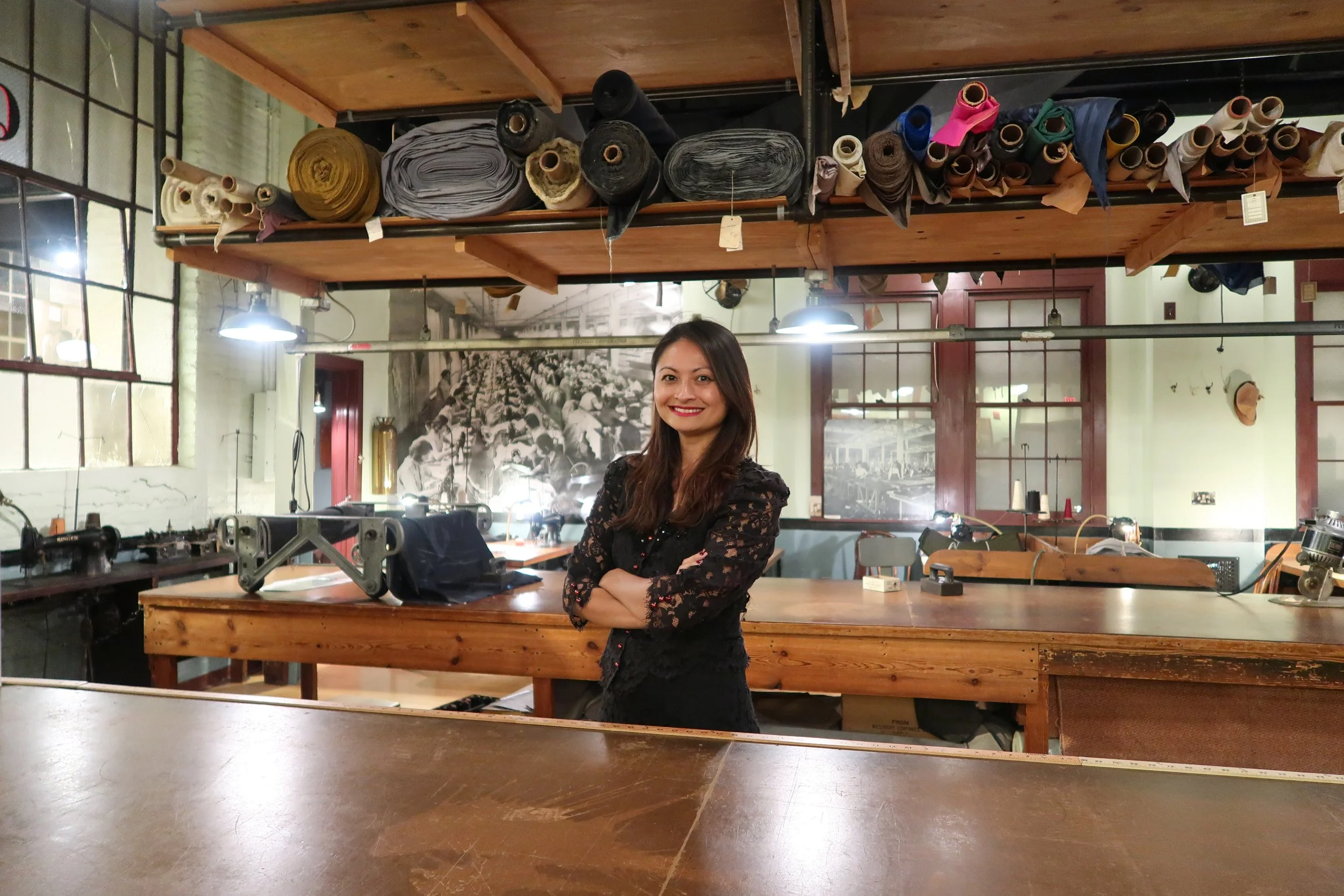
Inside a 1920s garment loft in Baltimore, sewing was an engine of economic life—connecting workers, manufacturers, entrepreneurs, and communities. Nearly a century later, what if that same sector could sew a new future around impact, innovation, and inclusion?